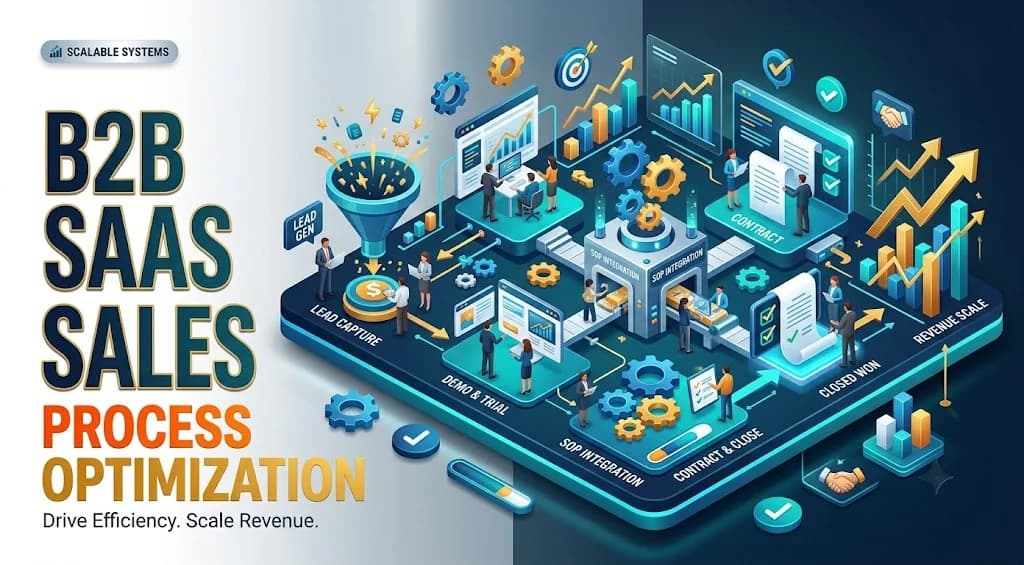
Introduction: Refactoring Your Sales Funnel for Maximum Throughput
In software development, we despise inefficient code, unnecessary latency, and redundant loops. Yet, many high-growth B2B SaaS companies operate sales organizations burdened by those exact system flaws. A bloated B2B SaaS sales process increases customer acquisition costs (CAC), drags out deal cycles, and degrades both buyer and seller experiences. If you think of your sales pipeline as an algorithmic workflow, optimization becomes a structured exercise in reducing friction, improving throughput, and eliminating dead code.
Optimizing your sales machinery requires moving away from guesswork and adopting a systematic, data-informed approach. By diagnosing pipeline bottlenecks with the same rigor used to debug production software, revenue teams can dramatically improve conversion rates and ARR growth. In this guide, we break down how to refactor your B2B SaaS sales process into a high-efficiency pipeline.
Architecting the Pipeline: Core Systems Insights
To optimize any complex process, you must first map its architecture and identify where resource bottlenecks occur. In B2B SaaS sales, friction typically manifests in three key stages: lead qualification, discovery, and deal closure. Treating these stages as connected API endpoints ensures smooth data flow and operational predictability.
- Automated Lead Triage: Unqualified leads act like invalid payload requests—they consume bandwidth without yielding value. Implement strict algorithmic scoring based on firmographic data, product usage metrics, and intent signals to automatically route qualified leads to the correct account executives.
- Standardized Discovery Inputs: Inconsistent discovery calls lead to unpredictable downstream outcomes. Standardizing discovery questionnaires creates deterministic data inputs, allowing sales representatives to identify actual pain points faster and position solutions accurately.
- Telemetry and Metric Tracking: Monitor stage-by-stage conversion velocity just as you would system latency. Tracking conversion rates between pipeline stages highlights precise failure points, enabling targeted interventions rather than blanket overhauls.
Actionable Strategies: Refactoring for Sales Velocity
Once system architecture is defined, execution relies on applying targeted optimizations across the deal lifecycle. Refactoring your sales stack involves eliminating manual labor and accelerating feedback loops.
1. Automate Routine Administrative Logic
Sales representatives frequently spend up to 60% of their operational hours updating CRMs, scheduling calls, and drafting routine follow-ups. Automate these low-yield background tasks through workflow orchestration engines and CRM triggers. Syncing calendar scheduling, automated email sequences, and native document generation frees reps to focus purely on high-leverage human interactions.
2. Deploy CI/CD to Messaging and Collateral
Static sales scripts quickly become obsolete. Implement a continuous integration approach to sales collateral. Regularly audit demo scripts, pitch decks, and objection handling matrices based on real-time win/loss analysis. Standardize the feedback loop between product management and sales to ensure product feature releases align immediately with value propositions presented to prospective buyers.
3. Streamline Legal and Technical Procurement
The security review and contract execution phases are often major sources of pipeline latency. Pre-compile standardized security documentation, SOC 2 compliance reports, and modular contract templates. Establishing clear conditional parameters for discounts or custom terms eliminates back-and-forth approval loops, significantly reducing sales cycle length.
Conclusion: Deploying Your Optimized Sales Stack
Optimizing a B2B SaaS sales process is not a one-time project; it is an ongoing process of continuous optimization. By identifying manual friction points, automating routine tasks, and applying algorithmic precision to pipeline management, your sales organization can operate with peak efficiency and predictable revenue growth.
Examine your current sales pipeline today. Treat every bottleneck as a bug to be fixed, refactor obsolete workflows, and build a scalable revenue engine tailored for sustained growth. Ready to upgrade your B2B SaaS sales velocity? Start by auditing your lead qualification stack and eliminating high-friction manual tasks today.
